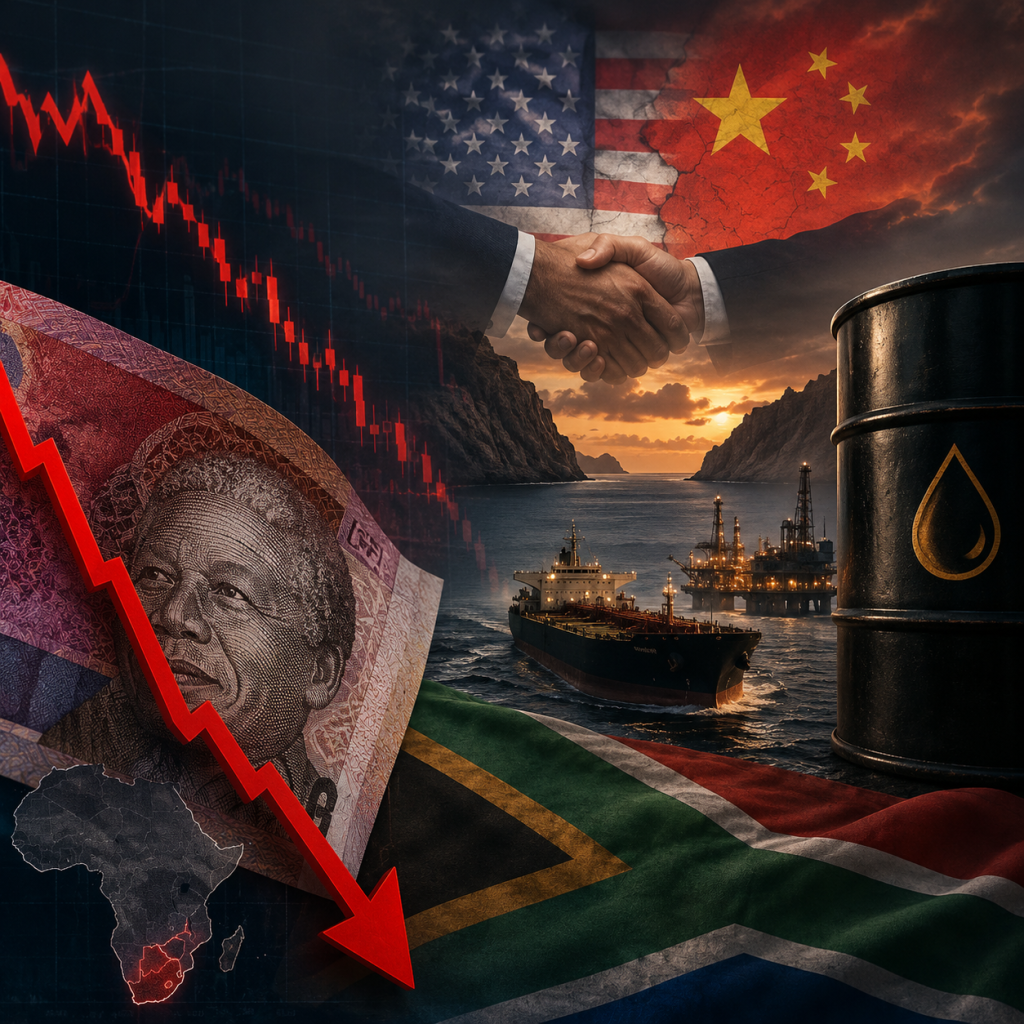

The South African rand fell sharply in early trade on Friday, sliding approximately 1% against the dollar to R16.64, as a combination of surging oil prices, a strengthening greenback, and unresolved geopolitical uncertainty converged on emerging market currencies following the conclusion of the two-day Trump-Xi summit in Beijing.
The greenback firmed against a basket of currencies and was on course for its biggest weekly gain in more than two months, compounding pressure on risk-sensitive currencies across the emerging market complex. Andre Cilliers, currency strategist at TreasuryONE, noted that the rand had weakened sharply in line with broader emerging market and commodity currencies, with rate hike and inflation fears weighing heavily on risk sentiment.
The immediate catalyst for the oil-driven pressure on risk assets was a pre-recorded statement by U.S. President Donald Trump, aired Thursday evening, in which he confirmed that China had agreed to purchase American crude. International benchmark Brent crude futures for July gained more than 1.49% to $107.30 a barrel, while U.S. West Texas Intermediate futures advanced 1.55% to $102.74 per barrel following Trump’s announcement. “They’ve agreed they want to buy oil from the United States, they’re going to go to Texas, we’re going to start sending Chinese ships to Texas and to Louisiana and to Alaska,” Trump stated.
U.S. crude oil exports to China had collapsed 95% from 2023 levels, to just 8.4 million barrels in 2025. The energy agreement, if confirmed by Beijing, would represent a material reversal of that trajectory. China’s authorities had not officially confirmed the energy purchase commitment as of Friday morning, though the market priced the announcement as directionally credible.
The summit produced a headline alignment on one of the most consequential choke points in the global energy system. According to the White House, the two sides agreed that the Strait of Hormuz must remain open to support the free flow of energy, with Trump also stating that China had reassured the U.S. it would not provide Iran with military equipment. That alignment carries significant weight: the conflict in the Middle East has curbed the global supply of fossil fuels as Iran has blocked maritime trade flows through the Strait of Hormuz, which usually carries around a fifth of the world’s oil and LNG. The disruption has interrupted approximately one-third of China’s LNG supply.
On trade, the summit delivered stated optimism without signed agreements. Trump described the bilateral discussions as producing “fantastic trade deals,” with talks primarily concentrated in the agriculture, aviation, and artificial intelligence sectors. Trump told Fox News that Xi had agreed to order 200 Boeing jets as part of the commercial commitments emerging from the summit.
Trump and Xi met on Friday for a tea session and working lunch to formally close the two-day summit, which featured structured pageantry and business dealmaking alongside a clear warning from Beijing that the Taiwan issue remains a determining factor in the trajectory of bilateral ties.
Despite the diplomatic optics, analysts remained measured on the substantive outcome. Wendy Cutler, senior vice president at the Asia Society Policy Institute, said that while the first day of meetings went as well as it could, there were no actual deliverables visible. “Each side has an interest in stability right now, but this doesn’t mean we’re going to become best friends,” she noted.
For South Africa and the broader African emerging market complex, the summit’s inconclusive energy dimension carries direct macroeconomic consequence. Rising oil above $100 per barrel extends the imported inflation cycle, limits the South African Reserve Bank’s room to ease monetary policy, and pressures the current account. A rand trading at R16.64 against the dollar amplifies fuel and food import costs at a moment when household consumption remains constrained.
South Africa’s JSE Top-40 index had gained 1% in early trade earlier in the week ahead of the summit’s conclusion, as markets priced in the prospect of a constructive Beijing outcome providing meaningful relief. The potential for China to help pressure Iran toward reopening the Strait had been described by market participants as enormously positive for oil prices, inflation, and global markets. Friday’s session reversed that cautious optimism, as oil’s continued elevation overrode the diplomatic goodwill.
South Africa’s benchmark 2035 government bond weakened in early Friday deals, with the yield rising 1 basis point to 8.765%. The move reflects a broader reassessment of sovereign risk across emerging markets as sticky energy inflation keeps rate cut expectations compressed.
The Strait of Hormuz remains the defining variable. Until maritime passage is genuinely normalised and oil retreats from triple-digit levels, the rand and African commodity markets face a structurally difficult environment, irrespective of the diplomatic language produced in Beijing.